
How much water does a plant need to stay healthy? How dry can the soil become before drought stress causes lasting damage?
For growers and horticultural researchers, understanding these thresholds can help improve irrigation practices, conserve water, and maintain plant health. A study conducted by researchers at Oregon State University explored these questions by evaluating drought tolerance and critical soil moisture levels in potted Mugo pine.
The research, Evaluating drought tolerance and critical moisture point of Pinus mugo potted in native silt loam soil, used the SAGE soil water tension sensor and HydraProbe System from Stevens Water Monitoring Systems to monitor soil conditions and evaluate irrigation thresholds.
The findings offer insight into how sensor-based irrigation decisions can help maintain plant health while allowing soil moisture to decrease between watering events.
Understanding Drought Tolerance in Mugo Pine
Mugo pine (Pinus mugo) is a slow-growing, drought-tolerant conifer commonly used in residential and commercial landscapes. However, drought tolerance does not mean a plant can survive indefinitely without water.
Identifying critical soil moisture levels is especially important for potted conifers. Drought stress may not become visually apparent until a plant has already experienced significant or irreversible damage. Monitoring soil conditions can provide an earlier indication of when irrigation is needed.
The Oregon State University study focused on ‘Pumilio’ Mugo pine grown in native silt loam soil. Researchers aimed to establish critical moisture levels using both soil water tension and volumetric water content.
By comparing different irrigation thresholds with a non-irrigated control, the researchers investigated how soil moisture management affected plant quality over time.
Using SAGE and HydraProbe to Monitor Soil Conditions
To evaluate the relationship between soil moisture and plant health, the research team established four treatments:
- 40 to 50 kPa: Irrigation applied when the SAGE reading reached this threshold range.
- 50 to 60 kPa: Irrigation applied at a moderately higher soil water tension.
- 60 to 80 kPa: Irrigation applied when the soil reached a higher water tension before watering.
- Non-irrigated control: Plants received no irrigation.
The experiment used a randomized complete block design with three replications. Irrigation treatments began on January 2, 2026.
Two Stevens Water monitoring technologies helped researchers track soil conditions throughout the study.
SAGE Soil Water Tension Sensor
The SAGE soil moisture sensor monitored soil water tension in kilopascals (kPa). This measurement indicates how strongly water is held in the soil and how difficult it is for plant roots to extract it. As soil dries, water tension generally increases.
SAGE readings were used to determine when each irrigation treatment received water, allowing researchers to compare plant responses under different watering thresholds.
HydraProbe Soil Sensor
The HydraProbe Soil Sensor monitored volumetric water content, providing a complementary measurement of the amount of water present in the soil.
Together, the two sensors allowed the researchers to evaluate irrigation timing using soil water tension while tracking changes in soil water content.
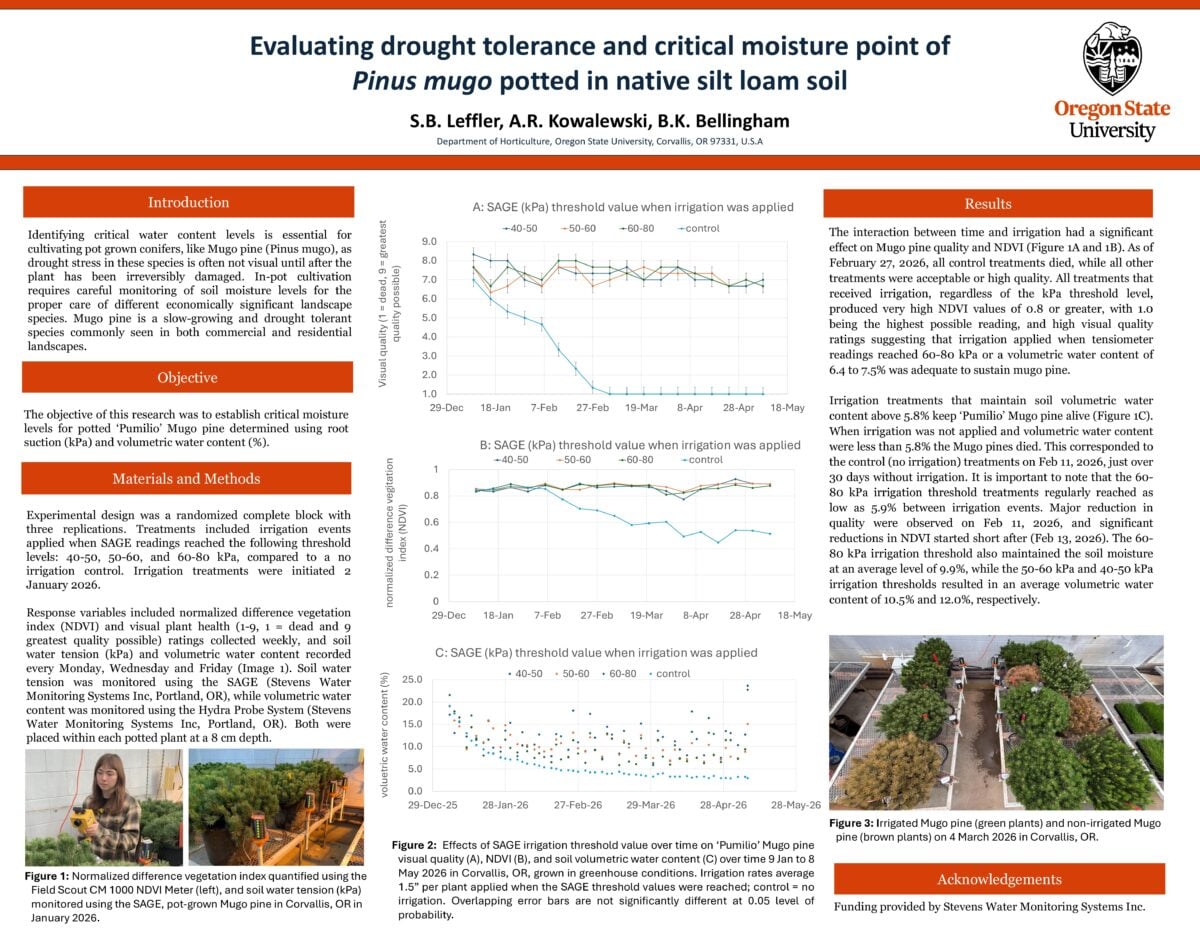
Both sensors were installed at an 8-centimeter depth within each potted plant. Researchers recorded soil water tension and volumetric water content on Mondays, Wednesdays, and Fridays.
Plant health was also evaluated weekly using visual quality ratings on a scale of 1 to 9, with 1 representing a dead plant and 9 representing the highest possible quality. Researchers also measured the normalized difference vegetation index (NDVI), an indicator of vegetation condition.
This combination of soil and plant measurements helped the team examine how different irrigation thresholds affected both growing conditions and plant performance.
What Did the Research Find?
The results demonstrated the importance of maintaining a minimum level of soil moisture to sustain potted Mugo pine.
By February 27, 2026, all plants in the non-irrigated control treatments had died, while the irrigated treatments maintained acceptable or high visual quality.
The researchers found that irrigation applied when SAGE readings reached the 60 to 80 kPa threshold range was adequate to sustain Mugo pine under the conditions of the study. This treatment corresponded to a volumetric water content range of approximately 6.4% to 7.5%.
The study also identified a critical moisture level associated with plant survival. Irrigation treatments that maintained volumetric water content above 5.8% kept the plants alive, while the non-irrigated plants died after soil moisture fell below that level.
The control plants reached this point after just over 30 days without irrigation, with mortality occurring as the soil continued to dry.
These findings highlight the value of monitoring soil conditions, rather than relying solely on visual symptoms of drought stress.
Balancing Irrigation and Plant Health
An important finding was that the plants receiving irrigation maintained high NDVI values of 0.8 or greater—with 1.0 representing the highest possible reading—alongside high visual quality ratings.
However, the irrigation thresholds produced different average soil moisture levels.
The 40 to 50 kPa treatment maintained an average volumetric water content of approximately 12.0%, while the 50 to 60 kPa treatment averaged 10.5%. The 60 to 80 kPa treatment averaged 9.9%.
The 60 to 80 kPa treatment therefore allowed the soil to maintain a lower average water content while still sustaining the plants during the study period.
Researchers also observed that this treatment regularly reached soil moisture levels as low as 5.9% between irrigation events. A reduction in visual quality was observed on February 11, followed by a decline in NDVI beginning shortly afterward.
This is a key distinction: allowing soil moisture to decrease between irrigation events may help reduce unnecessary watering. The results also show why monitoring critical moisture thresholds matters. The goal is not simply to apply less water—it is to maintain sufficient moisture for plant health while making irrigation decisions based on measurable conditions.
The findings apply to the specific plant material, soil, and growing conditions studied. Additional research would be needed to establish whether the same thresholds apply to other ornamental species, soil types, and growing environments.
Turning Soil Measurements into Better Irrigation Decisions
The study demonstrates how soil water tension and volumetric water content can work together to inform irrigation practices.
Soil water tension provides an indication of how tightly water is held in the soil, while volumetric water content measures the proportion of soil volume occupied by water. Examining both measurements alongside plant health indicators provides a more complete picture of how irrigation affects growing conditions.
For horticultural researchers and growers, this approach offers a way to investigate irrigation thresholds, monitor changes in soil moisture, and evaluate plant responses over time.
Rather than relying exclusively on a fixed watering schedule or waiting for visible signs of stress, sensor-based monitoring provides measurable information that can help guide irrigation timing.
Supporting Applied Research with Stevens Water Technology
Stevens Water Monitoring Systems develops soil and environmental monitoring technologies for research and real-world applications. In this study, SAGE and HydraProbe helped researchers evaluate the relationship between soil moisture, irrigation timing, and the health of potted Mugo pine.
The research illustrates how reliable soil measurements can support a detailed understanding of plant water requirements. By combining soil water tension, volumetric water content, and plant health assessments, researchers were able to identify moisture thresholds associated with sustaining the plants under the conditions tested.
Stevens Water is proud to have supported this research through study funding and monitoring technology.
As researchers continue exploring plant water requirements and irrigation management, accurate soil measurements remain an important tool for developing evidence-based growing practices.
Learn more about Stevens Water’s soil monitoring technology:
Explore the SAGE – Profession Soil Moisture Meter


